
Why TriAIQ
Why TriAIQ
AI-Assured Engineering Decisions Inside Real Organizations
AI accelerates engineering work.
Unvalidated AI introduces risk.
TriAIQ ensures AI-assisted engineering decisions are correct, defensible, and safe to scale.
We achieve this through disciplined triangulation of AI reasoning, statistical validation, and verified engineering execution.
Why Existing Approaches Fail in Engineering
Most AI adoption in engineering optimizes for speed — not correctness. Common approaches break down because they rely on:
- Prompting alone (no independent validation of outputs)
- Trusting a single model (no cross-check against statistical ground truth)
- Policy-based governance (rules without execution-level verification)
- Manual review at scale (too slow to sustain across teams)
TriAIQ replaces “trust the model” with a repeatable validation system — before decisions scale or automation begins.
Why TriAIQ Is Different from Typical AI Training
Typical AI Training
Prompt engineering without validation
AI tools without statistical verification
Governance policies without execution checks
Speed gains that increase decision risk
TriAIQ
Triangulated AI outputs
Statistical validation of engineering decisions
Verified execution in trusted engineering software
Automation only after decisions are defensible
Every TriAIQ Decision is Validated Through Three Independent Anchors
AI-Assisted Reasoning
Accelerates exploration and hypothesis generation
Statistical Methods
Ensures mathematical correctness and uncertainty awareness
Software Verification (JMP)
Confirms execution-level accuracy using trusted engineering tools
Automation proceeds only when all three anchors independently agree. This triangulation prevents silent AI failures and false confidence.
How TriAIQ Works: Decision Triangulation
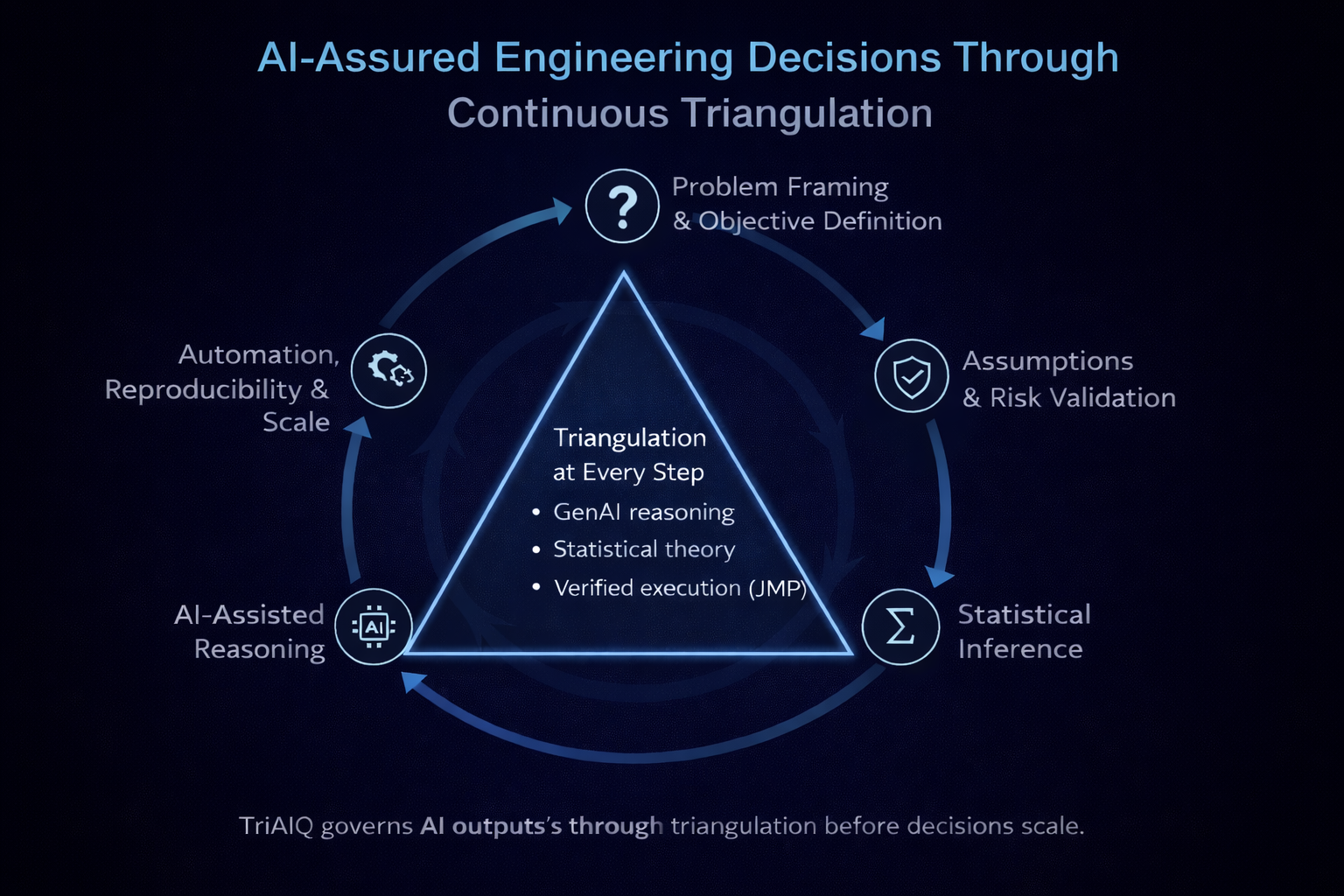
This is AI governance for engineering decisions: correctness, auditability, and safe scale — enforced through triangulation, not policy alone.
What Teams Get With TriAIQ
- Faster engineering decisions without sacrificing correctness
- Clear assumptions, uncertainty, and defensibility
- Reduced risk of silent AI failure and false confidence
- A path to enterprise-safe automation (behind the firewall)
From Insight to Enterprise-Safe Automation
TriAIQ guides teams from analysis to enterprise-safe automation:
> Correct problem framing
> Explicit assumption and risk validation
> Statistically sound inference
> AI-generated logic verified in JMP statistical software (by SAS)
> Automated tables and visuals for production use
Real production data never leaves the engineer’s machine.
Proven Across High-Impact Engineering Environments.
TriAIQ Training and Methods Used Across Leading Engineering Organizations

TriAIQ training experience spans across semiconductor, medical devices, cloud infrastructure, and consumer hardware organizations.
Experience includes enterprise training programs delivered to hundreds of engineers and engineering leaders across global technology organizations.
Why Engineering Organizations Choose TriAIQ
> Reduce costly engineering mistakes
> Standardize decision quality across teams
> Convert AI usage into measurable ROI
> Scale automation without increasing risk
> Enable program leaders to govern AI-assisted decisions without slowing execution
TriAIQ helps organizations justify AI investment by turning AI usage into engineering productivity, defensible decisions, and scalable automation.
An Operating Model — Not a Tool
- TriAIQ is not another AI platform.
- Unlike generic AI tools or training programs, TriAIQ implements a decision-assurance operating model that validates AI-assisted work before it scales.
- It is a decision-assurance operating model for engineering teams that need speed and certainty at the same time.
- Triangulation turns AI speed into trusted execution.
Most organizations start by applying triangulation on one real engineering decision workflow.
Start with a pilot
See how triangulation works in practice using your workflows, tools, and decision contexts.
See how Stage 4 is implemented in our Automation Workshop.